Top 7 Legal Answering Services for Law Firms (2026)


When you miss a call, you may lose a case. More importantly, you may lose the opportunity to work with a potential client to another firm. A top-notch legal answering service is expected to do more than simply take a message; a reputable answering service should allow your team to collect lead information, qualify leads to see if they fit your criteria, direct the most critical matters to the appropriate personnel, assist in scheduling consultations, and document the outcome of the call in a format that you can leverage to make decisions within your organization.
This article discusses seven options commonly considered by law firms in 2026. Rather than creating a straightforward list of 1 to 7, this article focuses on what each firm is best-suited for, what to watch out for, and how to compare them using the same operational framework you use to compare decision-making within your law firm.
Last Updated: February 2026
Disclaimer: Features, Pricing, Availability – All are subject to change; please verify with the provider directly for the most current information.
How Did We Select the Top Providers?
Many firms shop based on surface-level features (for example, 24/7, bilingual, legal intake) and then realize they wish they had selected a provider that consistently followed their guidelines. As such, the primary focus of this article is to provide an operational view of the various vendors.
We were looking for providers that, for the purpose of this study, demonstrated above-average performance in the following areas:
- Intake Depth and Lead Qualification: Are the providers capable of collecting the necessary facts, asking follow-up questions to validate the facts, and identifying disqualified leads without over-interviewing the callers?
- Script Control and Customization: Do you have the ability to establish routing rules by practice area, lead type, level of urgency, and prior relationship with the firm,m and can you modify the rules as necessary?
- Consistency and Training of Staff: Will callers speak with representatives who have knowledge of your firm’s procedure(s), and/or will every call be a blank slate?
- Coverage and Reliability: Are the hours of operation sufficient to meet your firm’s needs, and how do they manage overflow calls? What occurs during peak periods?
- Scheduling and Integration: If you schedule consults, can they do so in the same manner as your internal team utilizes their tools?
- Reporting and Quality Assurance: Can you measure results and not just call volume?
- Transparency in Cost and Flexibility: Is the pricing model transparent? Are there overage charges? Are there setup costs? Other contract-related terms and conditions?
Top Picks by Best Use Case
- Best for Deep Customization and Consistent Intake Execution: Veza Reception
- Best for Integrations and Tech-Focused Workflows: Smith.ai
- Best for Premium Tone and Polished Caller Experience: Ruby Receptionists
- Best for High Volume Lead Capture and 24/7 Oriented Intake: Nexa Receptionists
- Best for Legal-First Positioning and Common Attorney Workflows: Answering Legal
- Best for Scale in Multi-Department Environments: Alert Communications
- Best for Straightforward Legal Coverage for Small to Medium-Sized Firms: LEX Reception
Below is a more in-depth description of each provider, including who it fits best.
Veza Reception
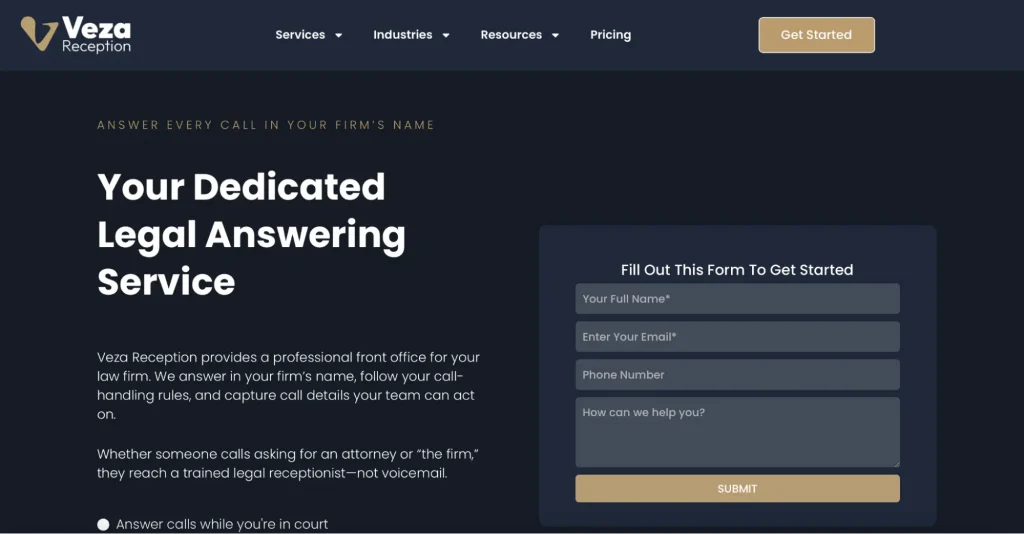
Veza Reception is a legal answering service for law firms, best suited for firms that want to customize their intake and use a dedicated pod of 5 to 8 agents to answer calls in line with firm standards.
Veza typically performs best when your intake is rule-based, and you place a high value on consistency in execution, for example, having different qualification rules for each practice area, clear rules for routing urgent matters, and specific disqualifiers that must be followed consistently.
When evaluating Veza, pay close attention to how scripts are gathered and maintained over time, how quickly updates can be approved and deployed, and whether reporting breaks outcomes down by practice area in a way your team can use for decision-making.
Smith.ai
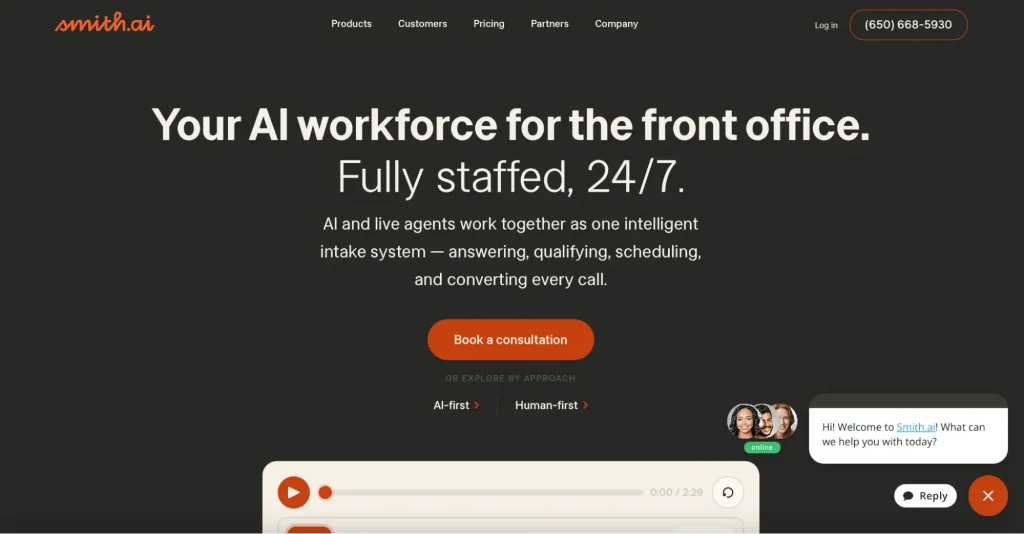
Smith.ai is best suited for firms that desire to have live answering and workflow automation, specifically around scheduling and CRM integration. Smith.ai is often utilized by firms that view intake as more than just messaging and want structured workflows, lead qualification, integrations, and reporting that can help law firms identify where intake leaks occur. Practices that require intake to have clean processes and reliable data will find that the strength of these features is an advantage.
Firms will need to be aware that automation is only as good as the systems it connects to. If the law practice’s scheduling rules are constantly changing or the CRM data is inaccurate, the integrations will not resolve the underlying issue. You should ask which integrations are native to the system, which are custom, and what was required to set them up. Additionally, you should ask if the system can schedule consults in the same manner that your staff does, including rescheduling and confirming appointments.
Ruby Receptionists
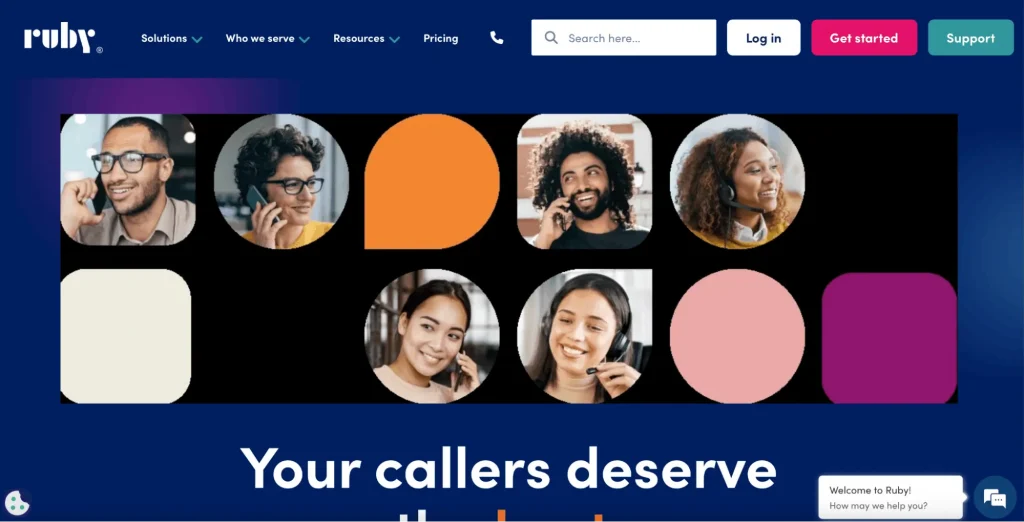
Ruby Receptionists is best suited for firms that want a professional, high-touch receptionist experience, where the caller’s tone and professionalism are a significant component of your image. Ruby typically receives positive comments when the call flow is relatively simple and the firm places a high value on professionalism, warmth, and a seamless experience for callers. Ruby is a good fit for firms that want every call to be treated professionally and with care, while still providing reliable live answering and message-taking.
Law firms that have intake that necessitates significant branching logic and rigid qualification rules will need to test how far Ruby can follow complex scripts and how outcomes are marked for their team. You may want to inquire how Ruby manages multi-branch scripts by practice area and what the process is for modifying and refreshing scripts.
Nexa Receptionists
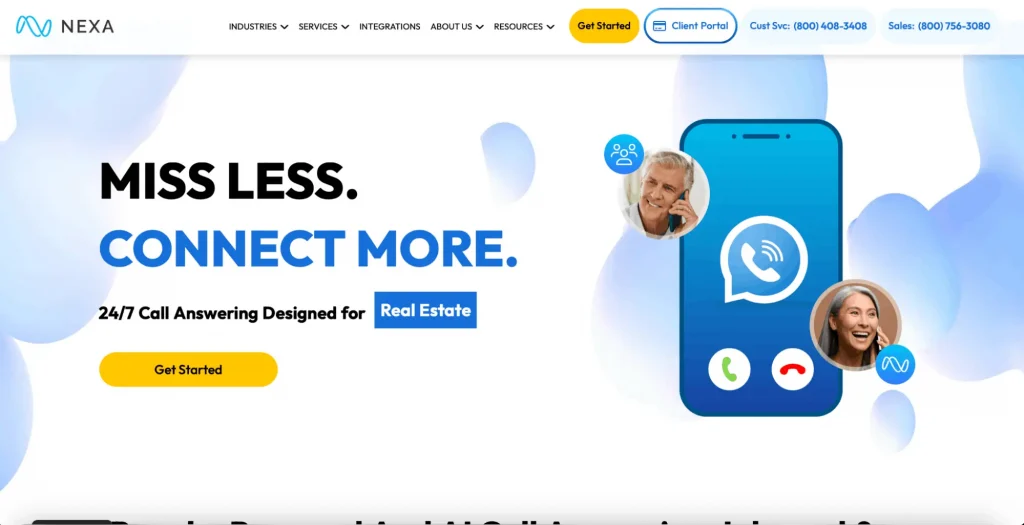
Nexa Receptionists is best suited for firms that want more robust contact center services, including higher-volume lead capture and 24/7-oriented services. Nexa is typically assessed by law firms that are actively producing leads, need extended hours, or need rapid consult booking at scale. In high-volume environments, the emphasis on coverage and consultation bookings can be beneficial for firms that prioritize speed and responsiveness across a large quantity of incoming inquiries.
The largest concern is ensuring quality while operating at a rapid pace. While speed is advantageous, it can produce problems if disqualifiers are not being enforced and consults are being scheduled that your team will ultimately decline. You should inquire as to how Nexa enforces disqualifiers and documents them, and whether Nexa provides a division of qualified versus unqualified outcomes by channel or practice area.
Answering Legal
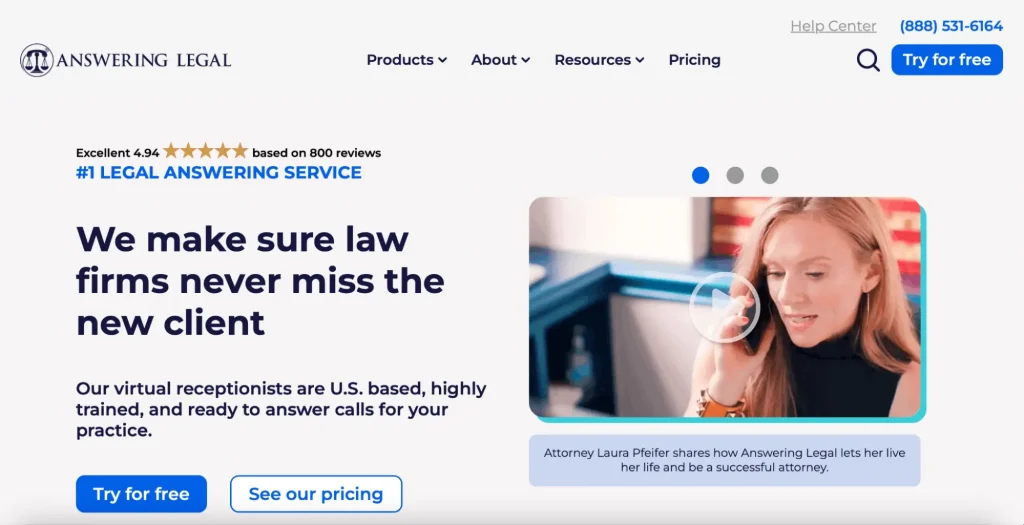
Answering Legal is best suited for firms that want a provider that is specialized in servicing attorneys and uses an intake that is developed with common law firm workflows in mind. Answering Legal is typically used by firms that desire to employ a legal-first approach to call handling, including screening, message-taking, and consultation booking, and where the call-handling process already adheres to common law firm intake practices. Many practices appreciate the legal orientation of Answering Legal as it minimizes friction because the scripting and expectations tend to mirror the fundamental principles of legal intake.
The main concern is that legal-specific does not necessarily mean “your law firm-specific.” The firm will still need to confirm how customizable the scripts are beyond the standard templates, especially if the law firm has multiple practice areas or nuanced rules. Some helpful questions to pose to Answering Legal include how many levels of branching they can accommodate in scripts per practice area and how they treat active-client calls versus new leads.
Alert Communications
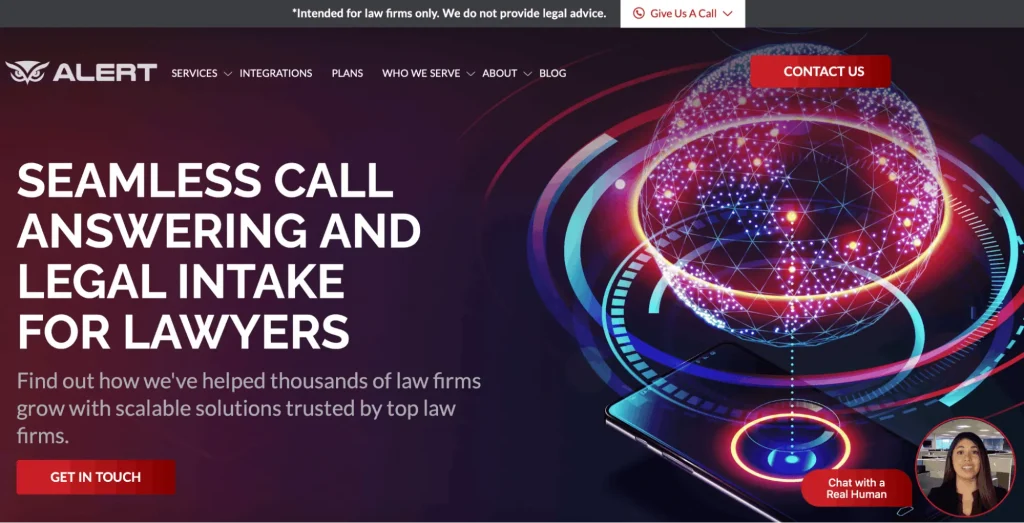
Alert Communications is best suited for mid-sized to larger firms that want to have structured intake and client communications at scale. Alert Communications is typically utilized by firms with multiple departments, more complicated routing requirements, or multi-location operations that require structured intake and coordinated interactions among teams. When a law firm wishes to utilize intake to support departmental workflows and greater operational complexity, Alert Communications is typically selected as a solution constructed for that level of complexity.
Given the larger size of implementations, the largest concern is timing. You may want to inquire regarding how routing rules are managed across departments, what quality assurance looks like, and how performance is monitored, including how frequently quality assurance reviews are conducted and reported.
LEX Reception
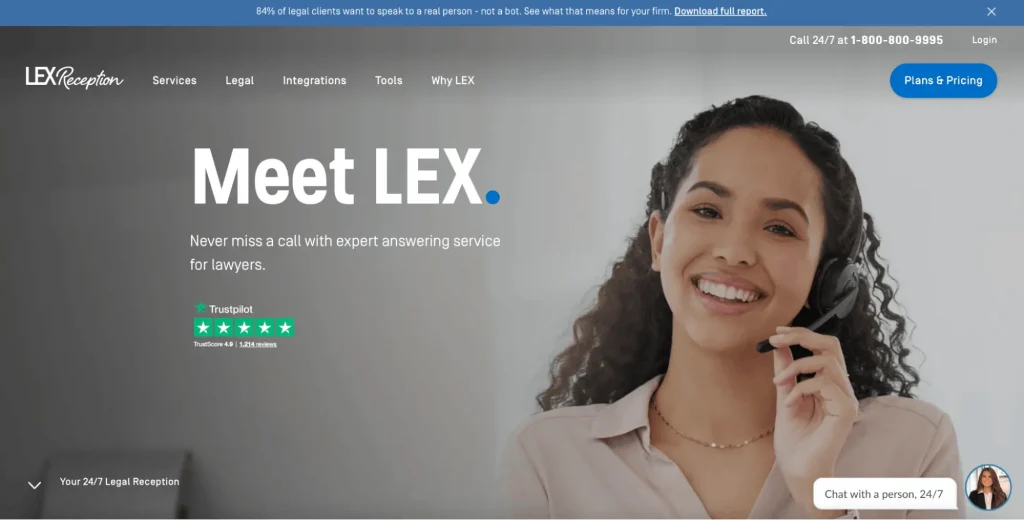
LEX Reception is best suited for firms that desire legal-oriented receptionist services, with intake and consultation bookings that remain uncomplicated. LEX is often selected by firms that desire a legal-facing provider, but do not want to incur the expense of a heavy customization burden, and it is generally suitable for smaller to mid-sized law practices that desire to maintain the scripts simple and executed reliably. If a firm desires to ensure that all calls are answered dependably, that messages are processed cleanly, and that appointments are booked reasonably, without a highly complex intake system, LEX is typically suitable for fulfilling that type of need.
If a firm has an intake that involves considerable rule-based parameters, then you may want to determine the extent to which the scripting can proceed, how outcomes are designated, and how modifications are made over time. You may want to inquire as to whether LEX can develop disqualifier rules and branching by practice area, and how LEX designates outcomes to enable you to follow up with clients efficiently.
Once you’ve narrowed your list to a few companies, pricing becomes the next big factor because it directly impacts your bottom line.
Pricing Models Explained (What to Watch Out for)
Providers charge differently, and the pricing model can affect your effective cost more than the headlined amount.
Typical pricing models include:
- Per-minute billing: Easy and simple, but monitor for overage rates and rounding rules
- Per-call billing: Penalizes for lengthy consult-like calls or complicated intake
- Monthly Packages: Convenient, but define what qualifies as included
- Hybrid: Base + Usage, or base + After Hours Surcharge
Questions About Costs That You Should Always Ask
- Are there setup fees, onboarding fees, or modification fees to revise scripts?
- How are minutes computed (rounding, minima)?
- Do After-Hours and Weekend Rates differ?
- What constitutes intake versus message taking, and does that impact your billings?
- What is the Cancellation Policy and Contract Term?
Notes on Compliance and Risk for Law Firms
A good answering service decreases your risk, but only if your guidelines are clear.
Inquire about:
- Confidentiality and Access Controls: Who can access intake data and recordings?
- Disclaimers: How do they manage the no legal advice boundaries?
- Conflict Sensitivity: What they can and cannot do during the initial intake?
- Recording of Calls: Consent regulations differ by jurisdiction; therefore, confirm how recording is performed and disclosed.
If you only have 20 minutes to evaluate vendors, use this quick test.
Step 1: Identify Your Intake Win Condition
One sentence. Example:
“Schedule Qualified Consults for PI and Employment, Reject Med Mal and Landlord Tenant, WARM TRANSFER ACTIVE CLIENT EMERGENCY.”
Step 2: Present Each Provider the Same Test Scenario
Present:
- A Qualified Lead Scenario
- An Unqualified Lead Scenario
- Active Client Urgent Scenario
Have them explain what they would ask, how it would be tagged, and how they would transfer the call.
Step 3: Insist Upon Outcome Tagging
At least:
- Qualified, Not Qualified
- Active Client
- Urgent
- Incorrect Practice Area
- No Contact, Request Call Back
If a provider cannot consistently tag outcomes, the reporting will be noise.
Step 4: Verify Rate of Script Modification
Your firm will alter its intake policies. If it takes weeks to revise scripts, your intake will deviate from being in sync with your firm.
In Summary
Veza Reception offers lots of script control and the most consistent qualification rules from the providers we looked at. If you’re looking for deeper integration and automation, Smith.ai is often a top choice. If your priority is having the best possible caller experience, Ruby is usually a leading option as well, with their 20+ years of experience. Nexa tends to stand out too for handling higher call volume. And if you want a provider that is truly legal first, you’ll likely compare Answering Legal, LEX Reception, and Veza Reception.
As you evaluate vendors, weigh these categories based on what your firm actually needs, such as the number of practice areas you handle, whether you require 24/7 coverage, your average call volume, and how you currently book consultations. That framework will help you land on the best fit for your practice.